We roll.
Rolling Interfaces for any motion.
- High efficiency and low wear.
- Motions not achievable from legacy mechanisms.
- CO₂ impact on the scale of LED lighting.
- > $10 Billion market.
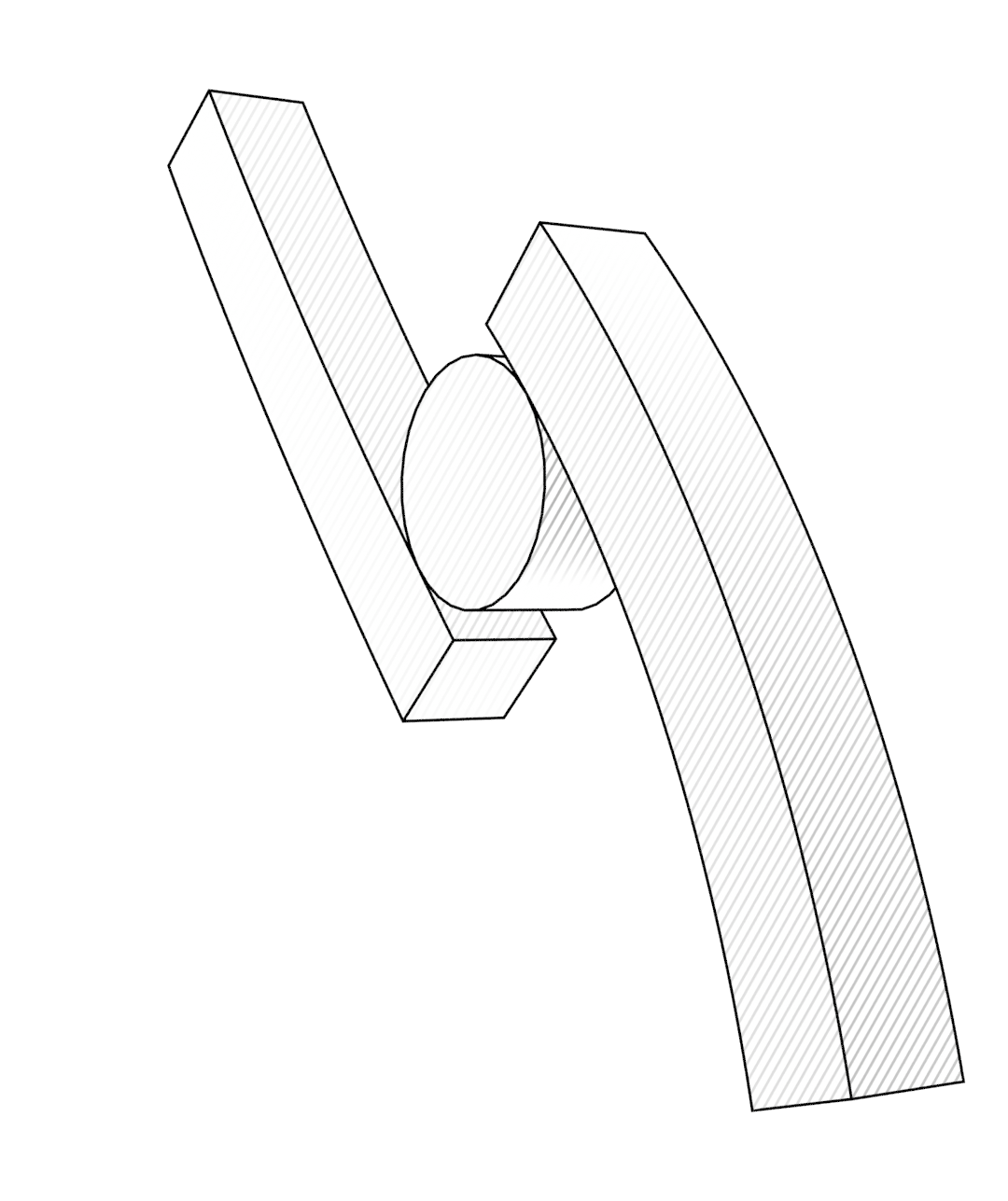 FIG. 1
The optimized
rolling interface.
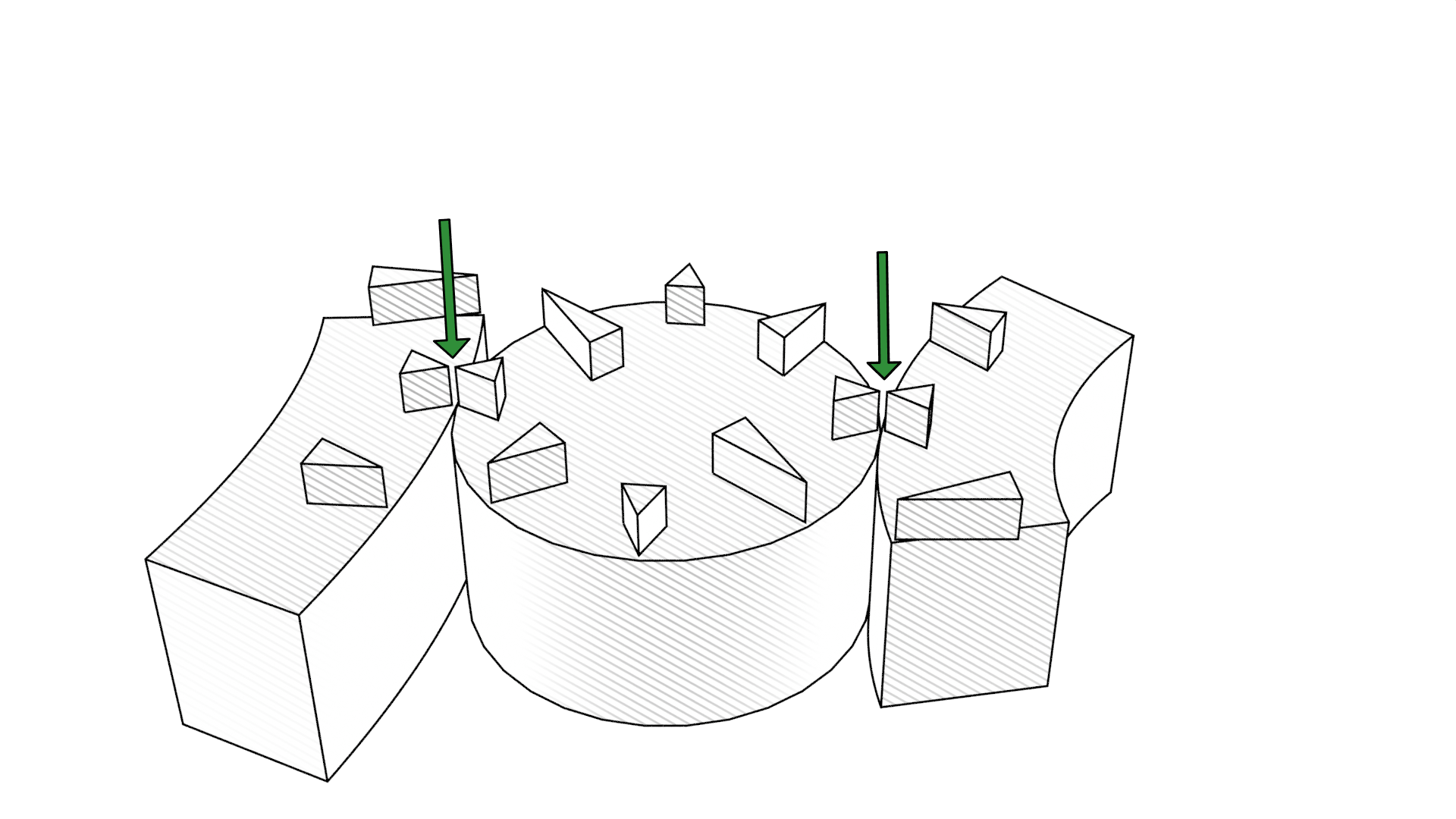
Roll's custom numerical methods optimize the raceway curvature to achieve pure rolling through the entire cycle. Optimized against un-optimized, each shown at the start and midpoint of the motion. See the animation.
 [ START ]
 [ MID ]
 [ START ]
 [ MID ]
Complex systems.
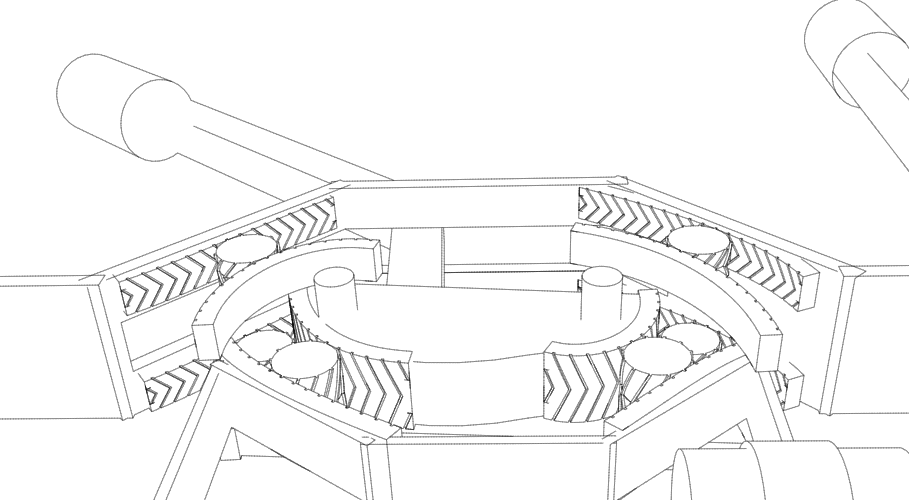
A kinematic first: multiple rolling interfaces, each precisely following its own motion specification, combine into systems that legacy mechanisms cannot achieve.
 [ CORKSCREW ]
Interfaces stacked into a system
Rolling interfaces combined in sequence, each contributing its own precisely specified motion.
See the corkscrew in motion →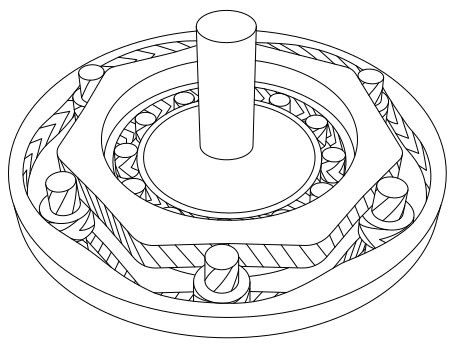 FIG. 5
Each interface follows its own path
Every interface is solved independently to trace the exact motion the system demands.
A novel retainer system.
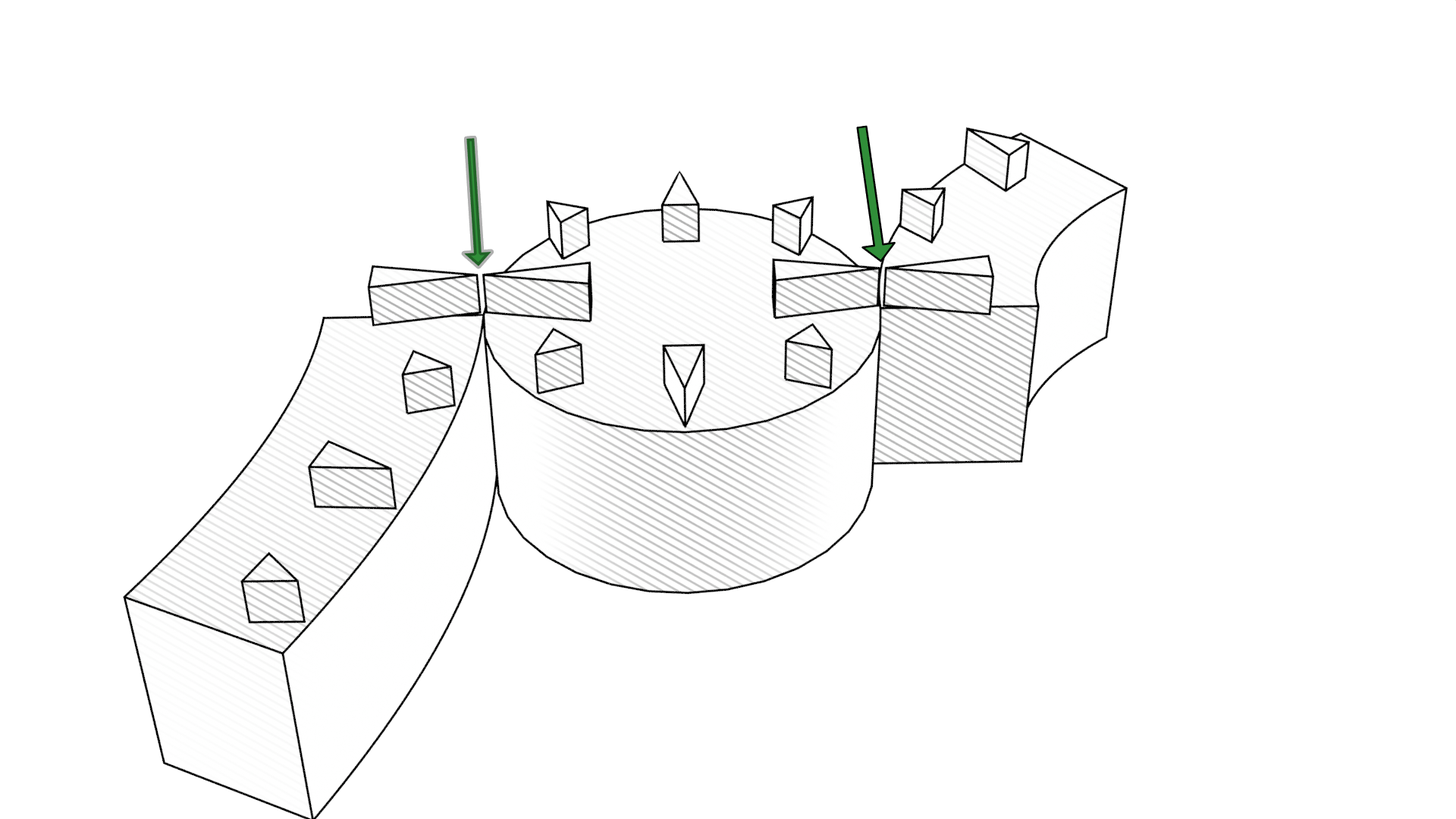
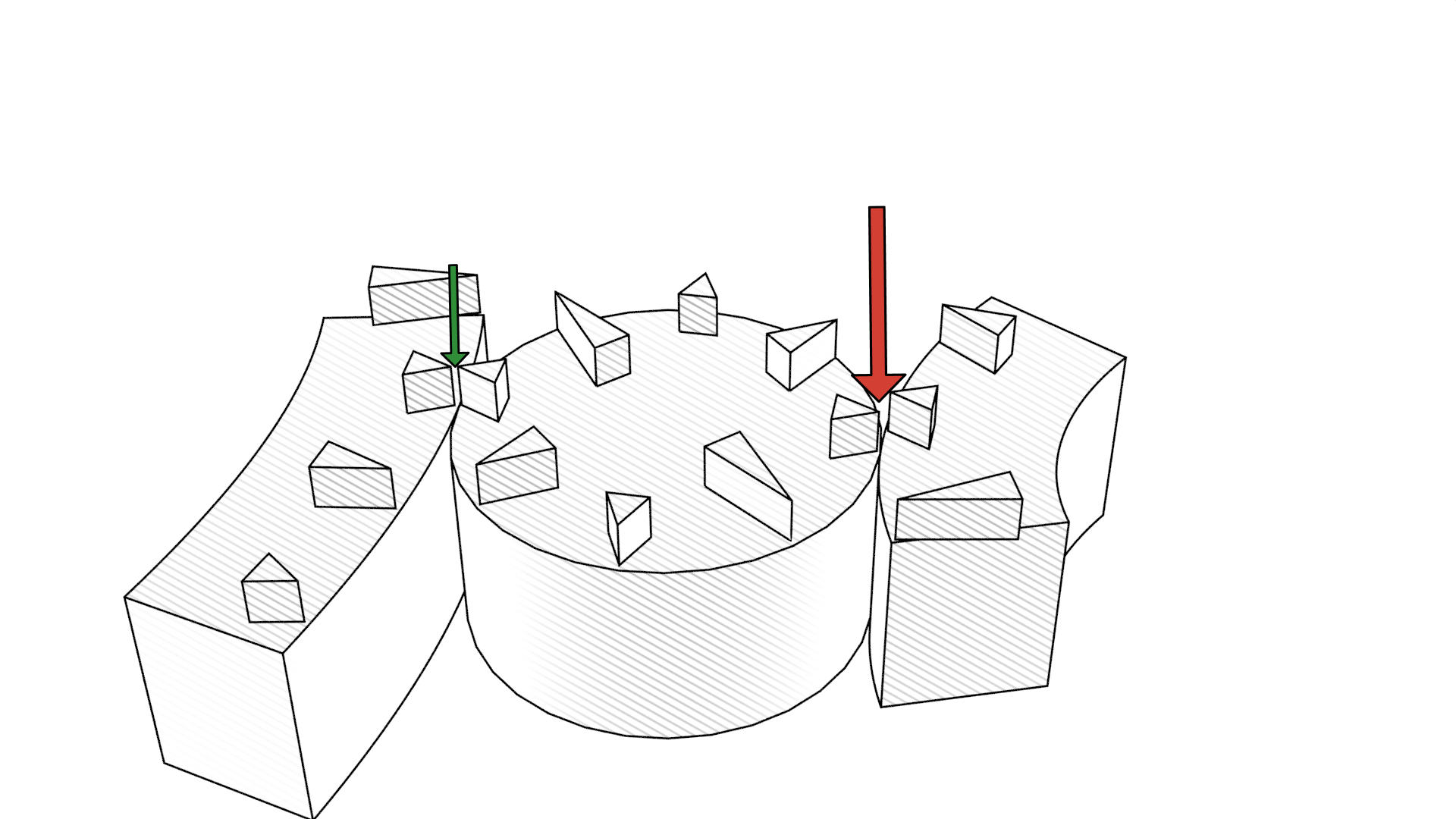
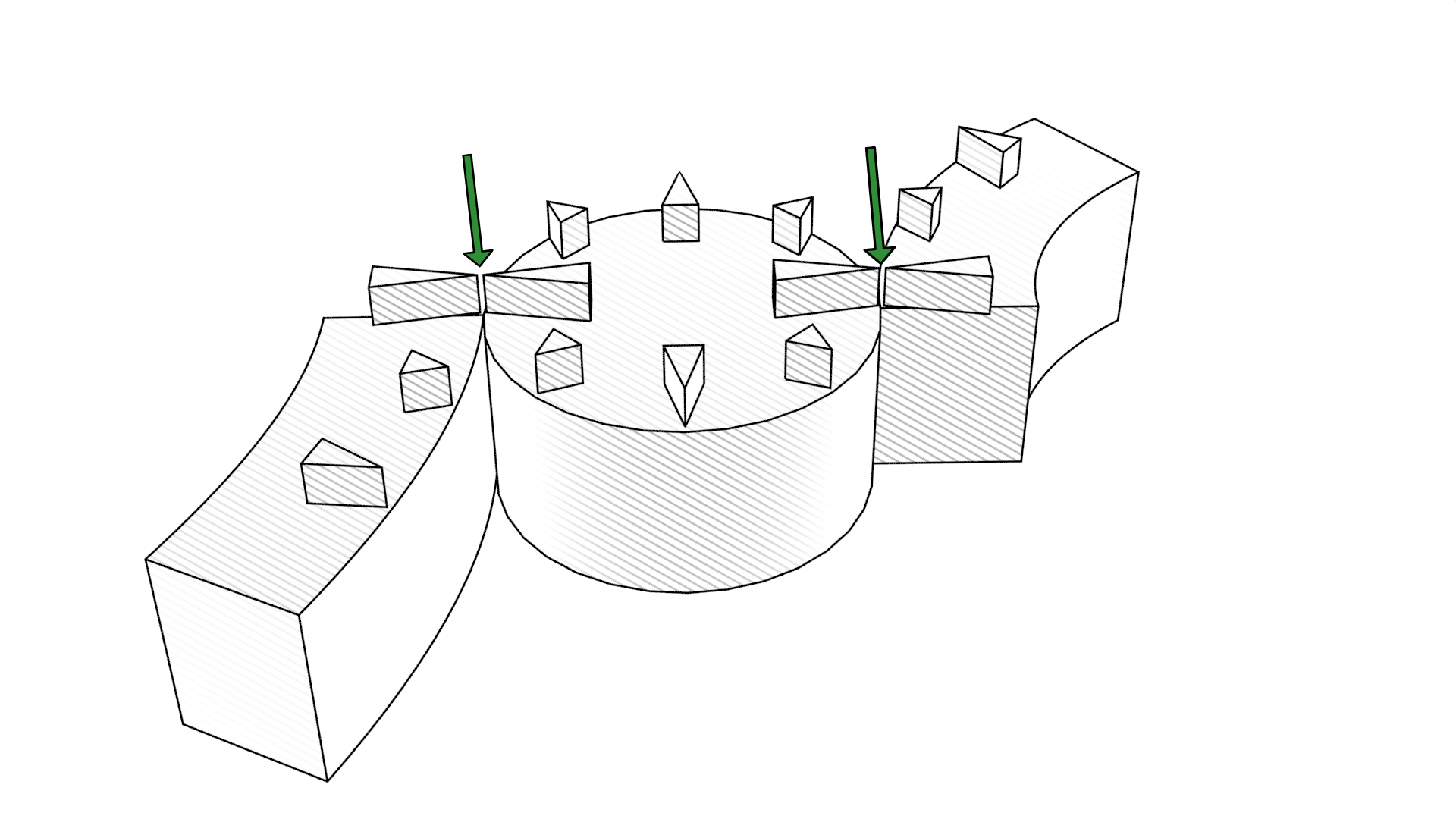
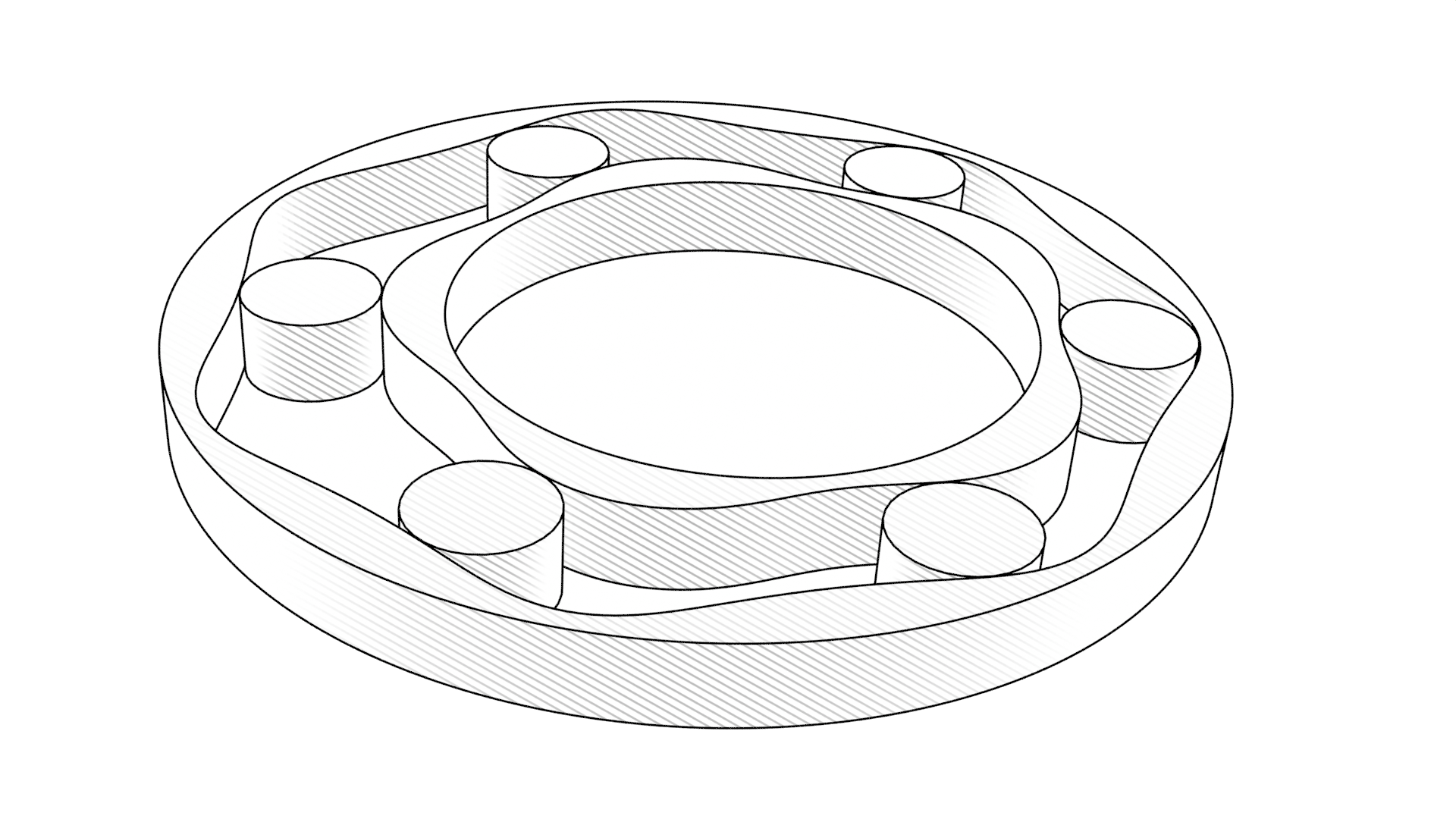
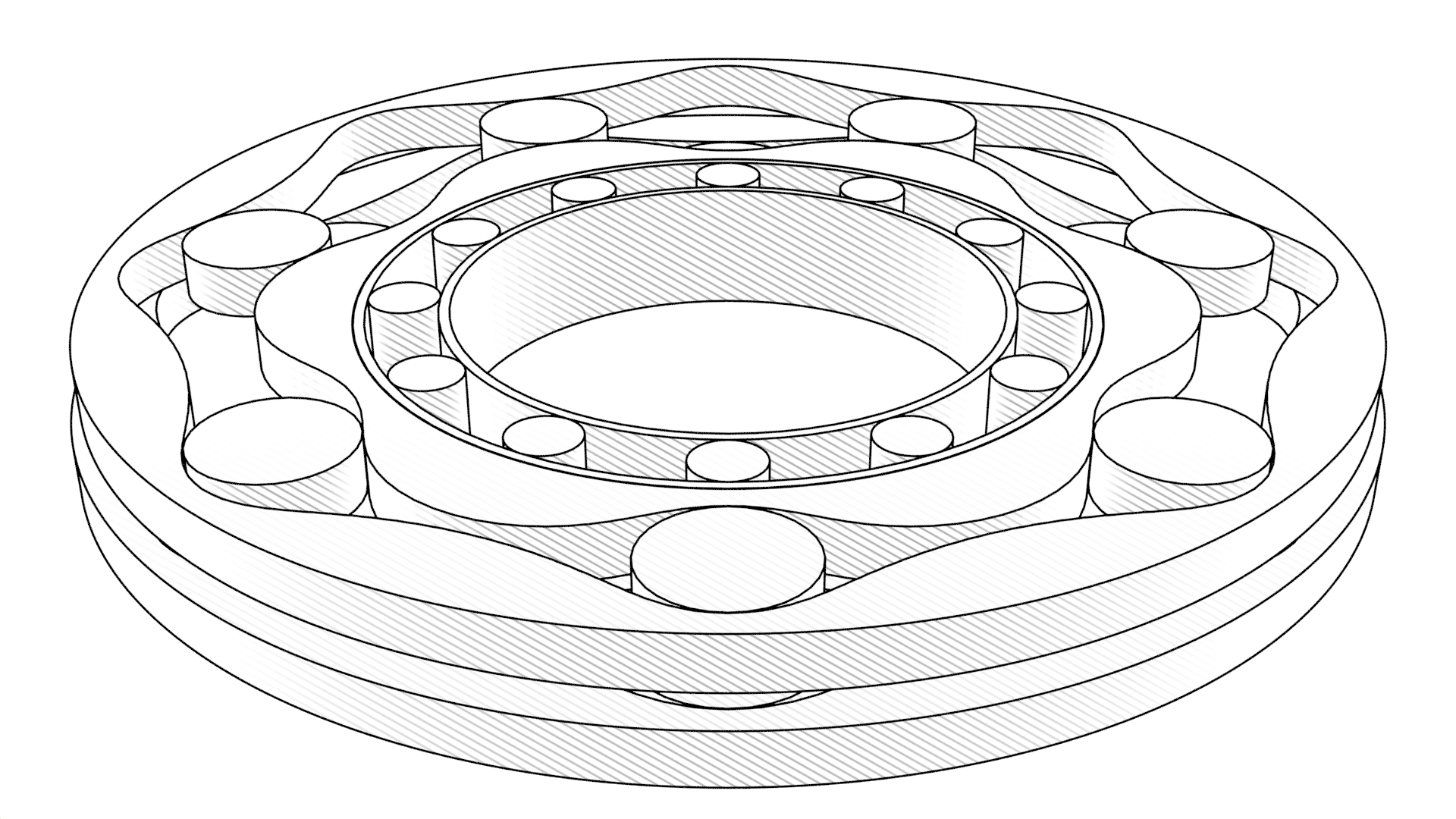
The rollers carry the load; a tongue-and-groove retainer keeps them precisely spaced and aligned as they travel the raceway. Shown below with and without it — so you can see exactly what the retainer adds.
 [ TAG — OFF ]
Rollers on the raceway
The load-carrying rollers seated in the shaped raceway, retainer removed.
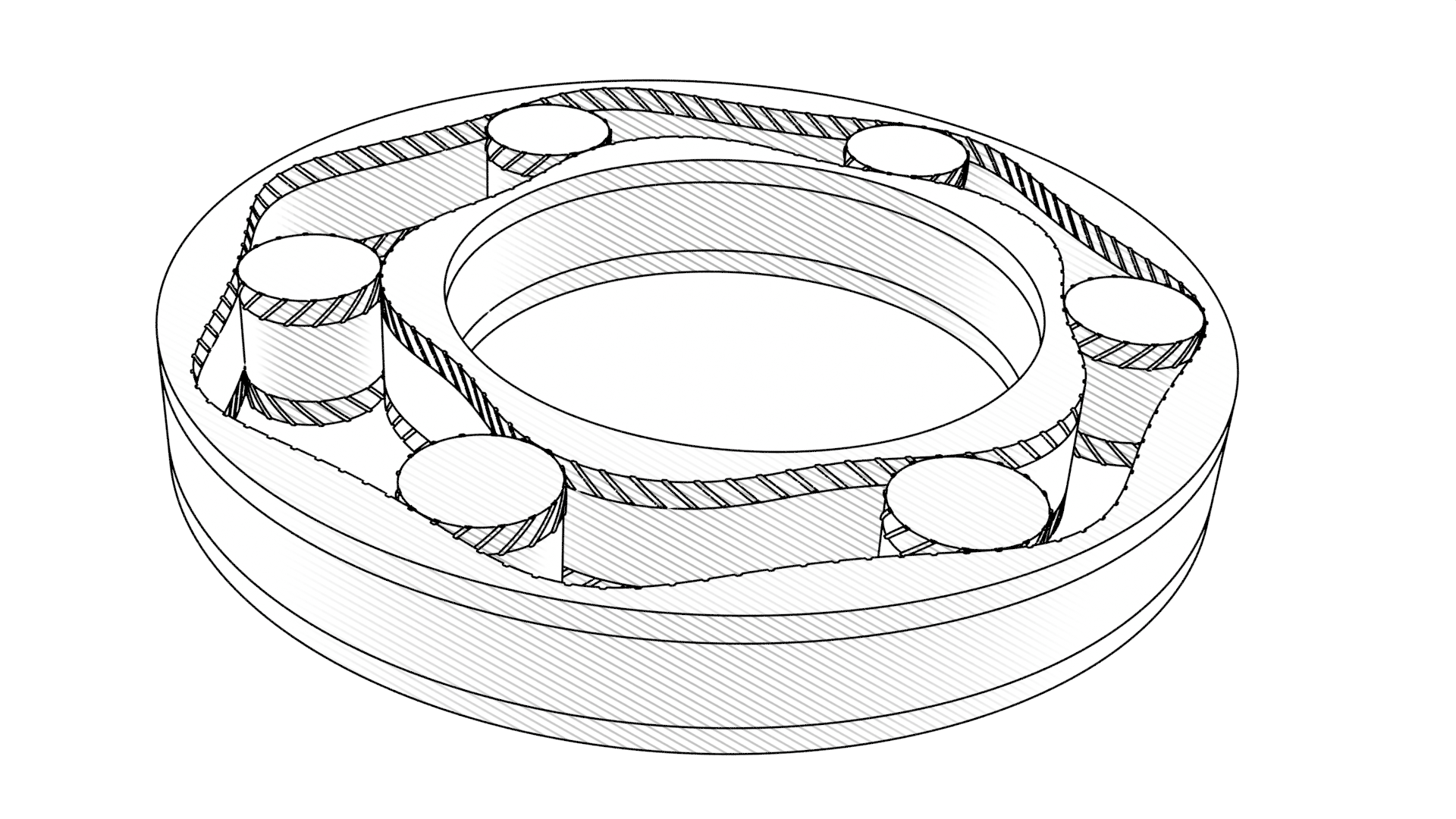 [ TAG — ON ]
With the retainer added
The tongue-and-groove retainer added — spacing and aligning the rollers along their path.
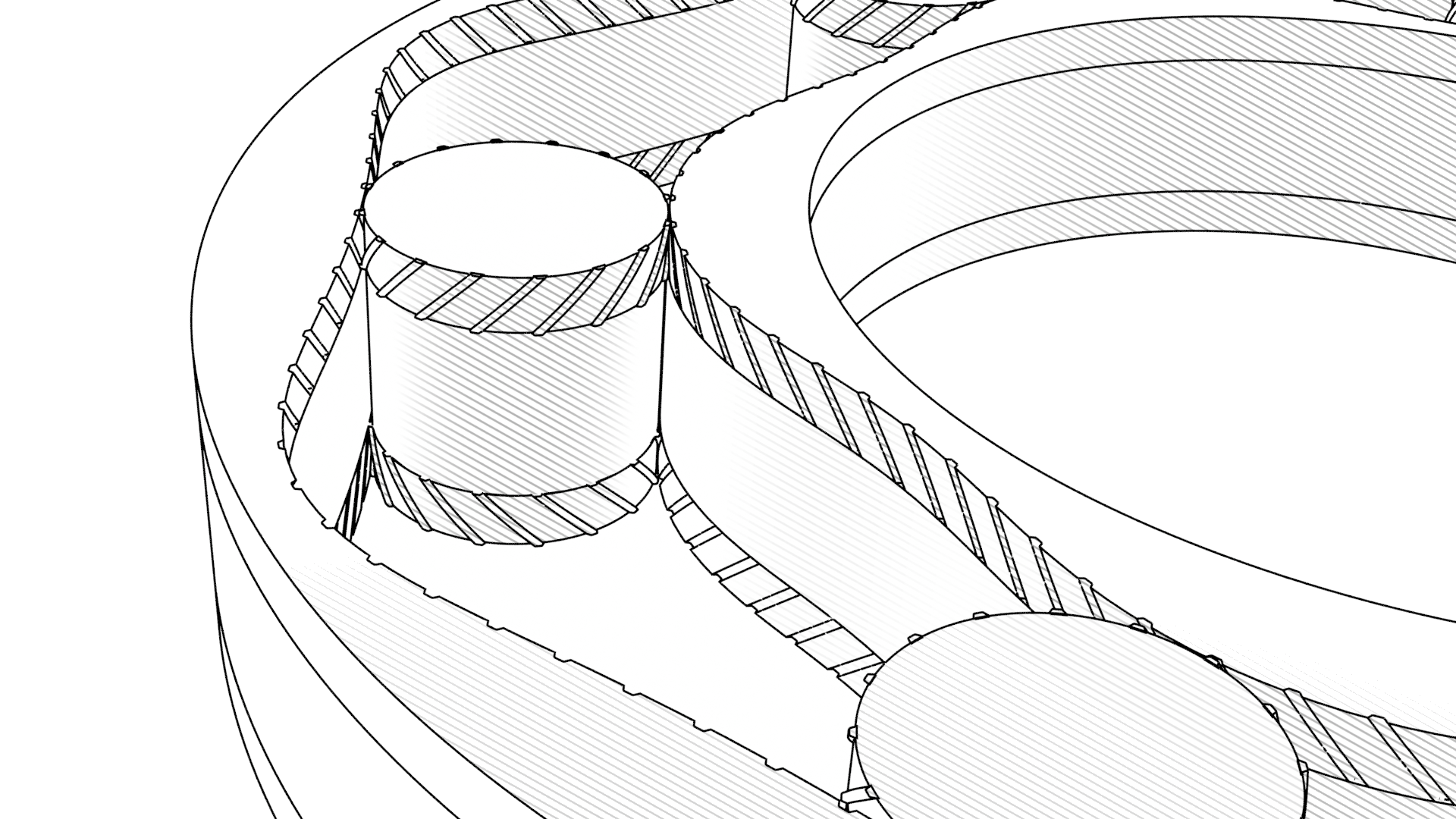 DETAIL — TONGUE & GROOVE
One pin, captured.
A single roller held between the two retainer bands. Their stepped tongue-and-groove edges interlock above and below the roller, keeping it on its path while it rolls freely — the retainer guides, it doesn't carry the load.
 SPEED REDUCER
The speed reducer.
A target of ~99% efficiency against roughly 60–80% for the harmonic drives it can replace. Even ~97% validated would be a major improvement — and pure rolling means less wear and longer service life.
Where the energy goes.
Between a motor and its load sits a speed reducer. For millennia the answer has been gears — teeth that mesh and slide against one another. Separating the loss terms of a geared reduction shows what the rolling element changes, and what it leaves alone.
One loss term is removed. The rest set the floor.
| Loss term | Effect | Evidence today | |
|---|---|---|---|
| Removed | Sliding at the load-bearing contact, at every gear mesh | Removed | From the raceway solution; simulated, not measured under load |
| Reduced | Lubricant pump and cooling | Likely reduced — less heat and fewer particles to manage | Expectation; not measured |
| Unchanged | Support bearings, churning, windage, seal drag | Nothing. These remain and set the floor | Not affected by this work |
| Open | Loss at the rolling contact under load; retainer loss | Present in both; the retainer contact rotates rather than slides | Expectation from kinematics; no data — both are test purposes |
~99%target — the efficiency of a bearing with the function of a gearbox. A design target pending validation, not a result.
The benchmark is measured, not quoted. The test program builds its own baseline: a geared reduction of equal ratio, instrumented on the same rig alongside the rolling element.
Carbon impact on the scale of LEDs and carbon capture.
Adopted globally, the technology could avoid an estimated half a gigaton of CO₂ a year — on the scale of LED lighting. Our own arithmetic, built from public energy data, puts the range at 0.2 to 1.3 gigatons; independent AI estimates land in the same band. The figures are modeled, pending hardware validation. We state them anyway, because the size of the number is the point — this is more than a novelty.
A modeled estimate, not a measured result. Efficiency figures are targets; physical validation is the next phase.
One mechanism.
A family of products.
Anything that spins is a candidate — pumps, robots, EVs, compressors, engines. Prove the rolling interface once, then apply it across a growing family of products.
Speed Reducer
The flagship — a ~99% efficiency target, pure rolling, and longer service life in place of legacy harmonic drives.
Adopted globally, the speed reducer could avoid about half a gigaton of CO₂ a year — on the scale of LED lighting. Modeled, pending validation.
Torque De-rippler
Momentarily increases the speed reduction to reflect excess torque back into the originating device — reducing vibration and increasing energy efficiency. Validated in simulation; a working prototype is the next step.
With our unique capability to achieve any motion, the de-rippler is the first of many devices targeted at improved thermodynamic efficiency, mass balancing, and vibration.
What's next
Fully 3D interfaces. (In development) Targeting complex mechanisms with six-axis motion and six-axis forces — biomechanics (kinematic joint matching) and robotic walking.
Complex systems delivering improved thermodynamic efficiency — efficient pumps, compressors, and combustion systems.
The missing building block.
Every machine is built from the same handful of parts — gears, bearings, shafts, linkages — all more than 500 years old. Where they fall short, no amount of engineering has ever fixed it: the crankcase still can't trace an efficient thermodynamic cycle after 150 years of failed attempts to replace it. It was never the engineers — it was the toolkit. Rolling interfaces add a new part to that box: precise, specified motion carried through pure rolling contact. Drop it where the old parts fall short and the results may astound.
Efficient thermodynamic cycles
Precise motion sharpens compression and combustion: engines, pumps, HVAC, refrigeration. The torque de-rippler is first in this line, with more coming.
Precise mechanisms
The same precision matters across countless mechanisms. Biomechanics is next.
 [ FOUNDER ]
One mechanism, two ambitions — built by one engineer.
Roll Labs (formerly 21Geo) invented rolling interfaces — a genuinely new type of mechanism, and arguably the first new mechanical building block in centuries. It carries two ambitions at once: replacing the meshing and sliding inside legacy motion parts with pure rolling, for far higher efficiency and longer life; and unlocking precise motions the old building blocks can't produce. The torque de-rippler is our first entry into that “any motion” frontier, with biomechanics and thermodynamic devices to follow.
The work is founder Tom Dobroth's. An MIT mechanical engineer (SB '83, SM '85), he once cracked a major industrial problem by inventing a numerical method for estimating free-surface fluid-flow shapes — and today he applies that same approach to computing the pure-rolling raceway geometries at the heart of Roll Labs. The vision has always been larger than one person; the goal now is to carry it from validated models to physical proof. Two granted U.S. patents protect the work, with a third pending.
Let's put rolling to work.
We're seeking mission-aligned partners and non-dilutive funding to move from validated models to physical results.