Two questions
we hear first.
The drawings look like things engineers already know. Two pictures settle it: where the force goes, and how many places it goes through.
Is this a gear?
No. A gear carries its load on teeth that mesh and slide. This carries its load on a pin rolling between two shaped raceways. Power crosses the rolling contact itself.
The tell is in the statics. A tooth force is tangent to the rim, so a gear has to be held: the shaft and its bearing balance the force, and the torque leaves through the shaft. A roller is touched in two places, and the two forces line up through its center and close through the body. Gears have shafts. Rollers don't.
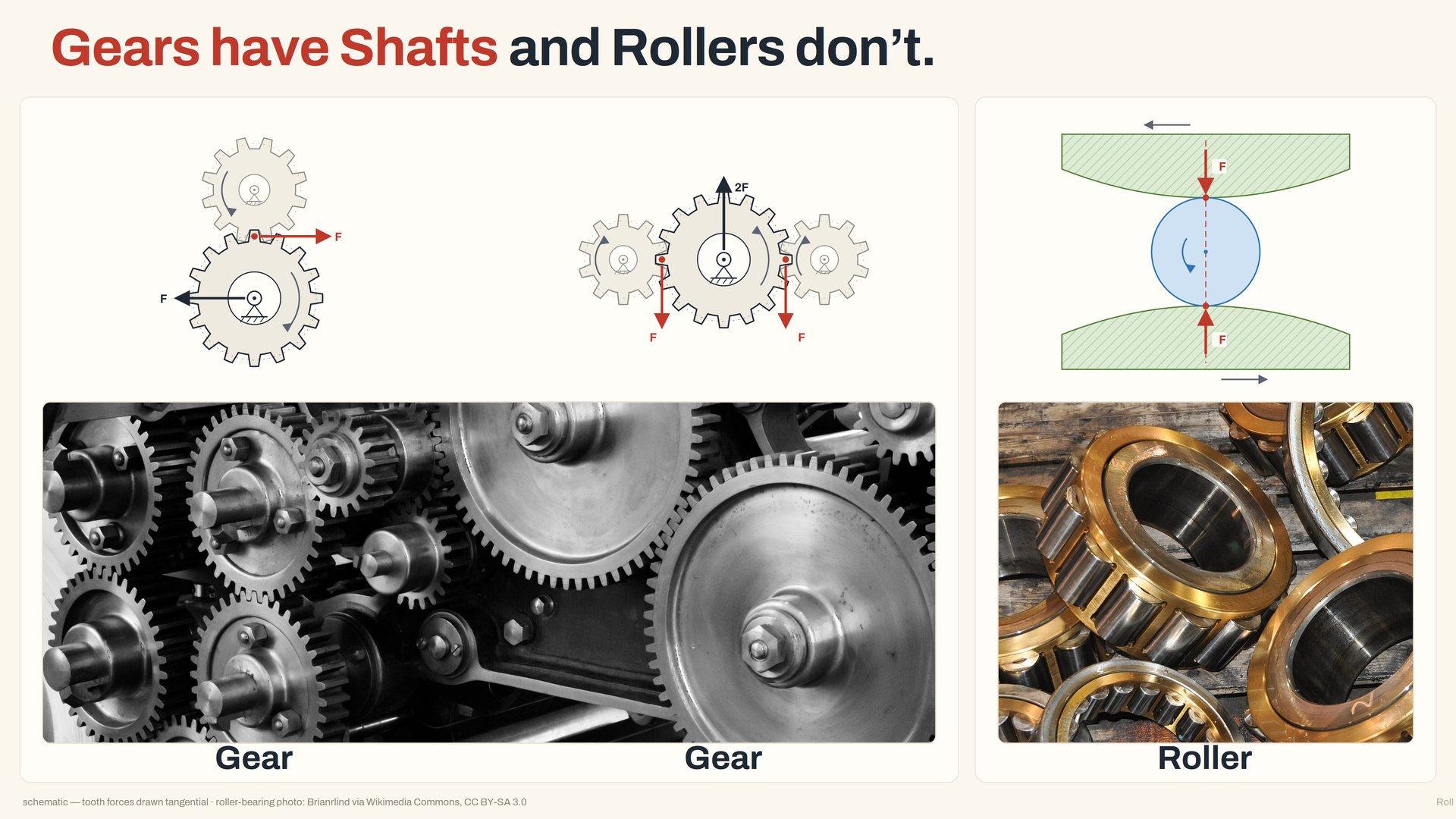
Every gear in the photograph is on a shaft. The rollers hold themselves. Roller-bearing photo: Brianrlind via Wikimedia Commons, CC BY-SA 3.0.
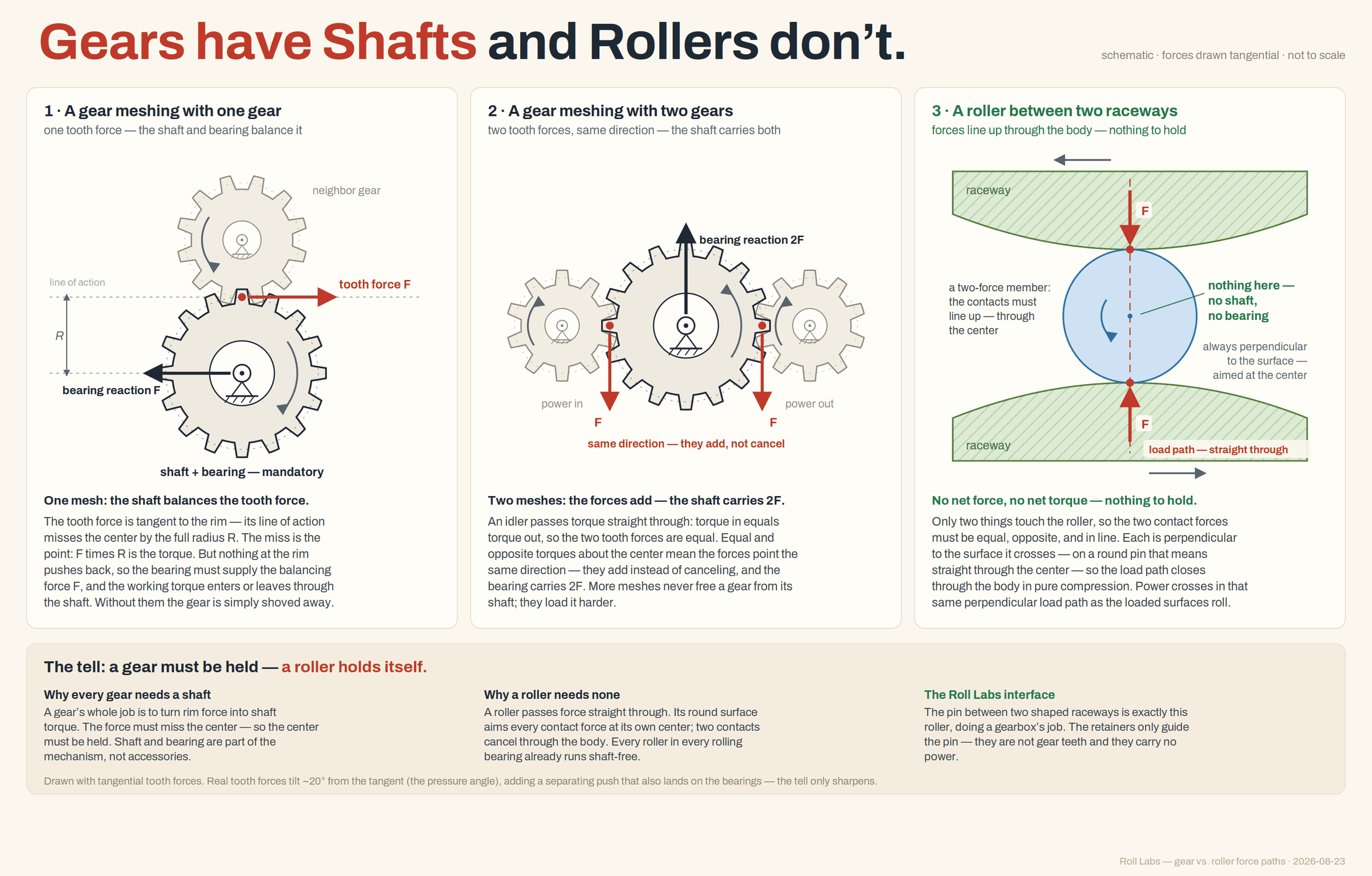
The same three cases, worked through. Schematic — tooth forces drawn tangential; real tooth forces tilt about 20°, which adds a separating push that also lands on the bearings.
In the speed reducer the pin between two shaped raceways is exactly this roller, doing a gearbox's job. The retainers guide the pins at their edges and carry no power.
Is this a traction drive?
No. A traction drive carries torque by friction at a preloaded rolling contact. The preload is a squeeze, the torque rides on the friction it creates, and above a slip torque the drive lets go.
Here the load crosses as a normal force between the pin and a shaped raceway — positive engagement, as with a tooth, and no slip torque. It sits in the pin-and-raceway family, in production since the 1920s. The difference is the raceway shape, computed so the pin rolls without sliding. Count the contacts: a roller has two, and no torque passes through it. A traction pin needs three or more, and the torque passes through its body.
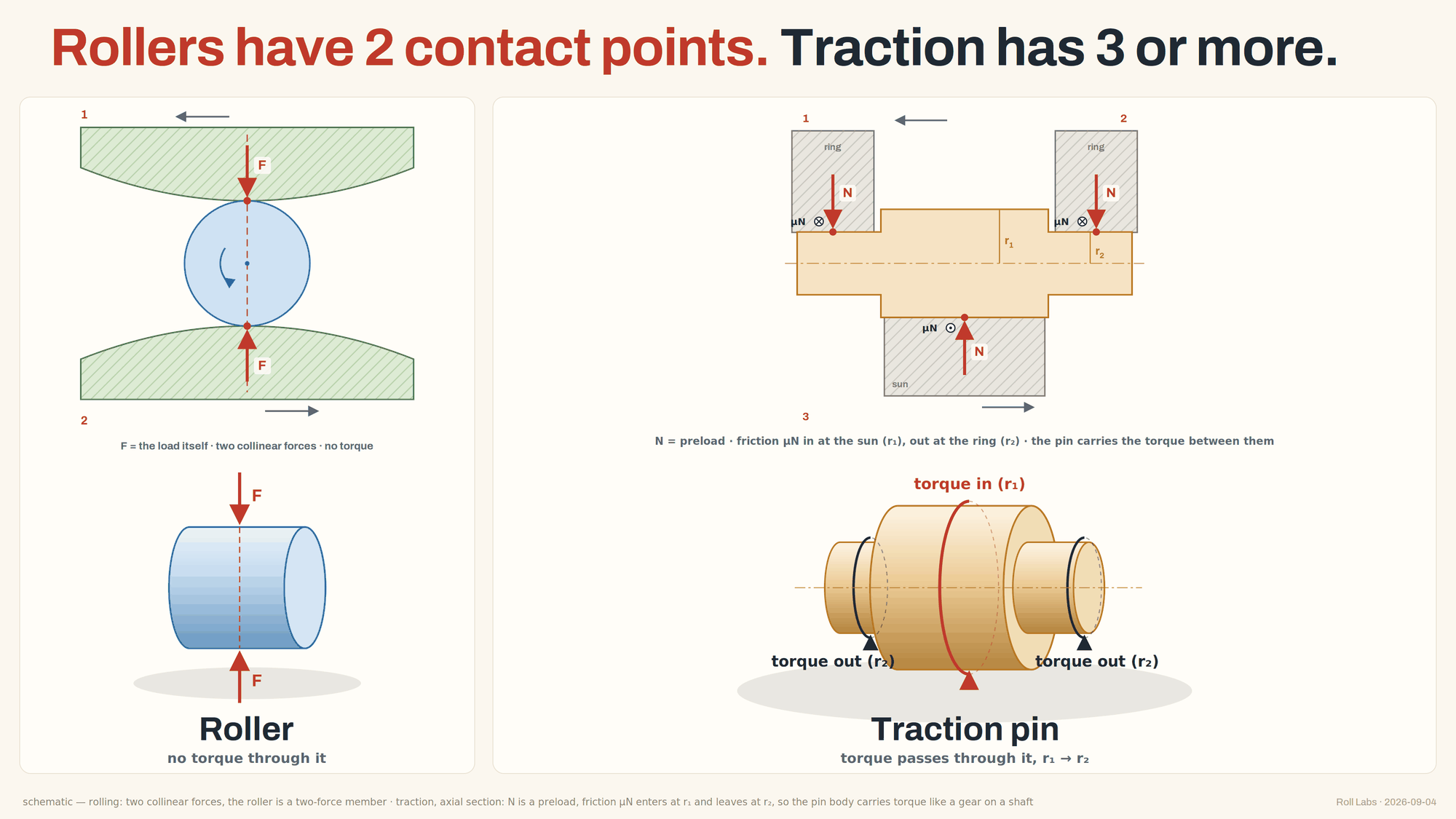
Rolling: two collinear forces; the roller is a two-force member. Traction: N is a preload, friction µN enters at r₁ and leaves at r₂, so the pin body carries torque like a gear on a shaft.
Figures are schematic statics at the level of the granted patents. Efficiency figures quoted elsewhere on this site are targets, pending physical validation.